
Understanding PeopleKeys Assessments
PeopleKeys utilizes four tools: DISC, TEAMS, Values, and BAI, in conjunction with performance benchmarks to provide a legal, predictable, and accurate matching tool for organizational success.
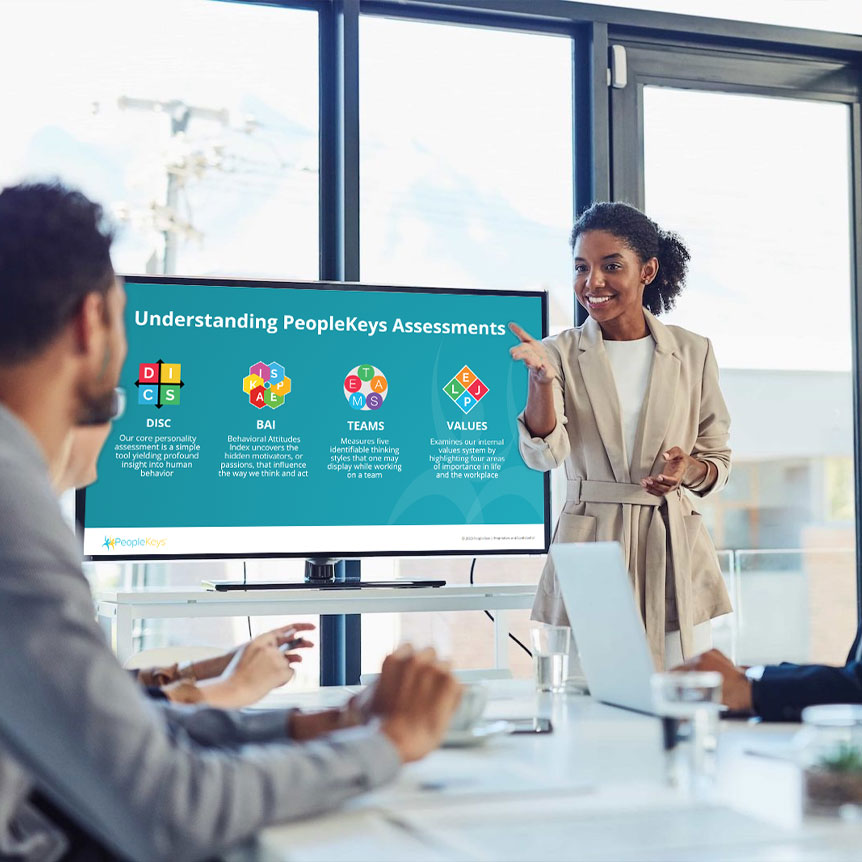

Assessments at a Glance
PeopleKeys offers a variety of assessments, including DISC, TEAMS, Values, and BAI, that work together to provide a comprehensive view of human behavior and motivation. These tools are designed to help individuals understand themselves and others more effectively, making them valuable in workplaces, schools, coaching, and personal development.
DISC reveals communication and behavioral styles, TEAMS highlights natural roles within a group, Values uncovers core drivers and decision-making influences, and the BAI (Behavioral Attitudes Index) explores deeper attitudes and passions. Together, these tools give individuals and organizations powerful insights to improve communication, strengthen teamwork, and unlock potential.
Build Your Report
Every report starts with DISC. Add TEAMS, Values or BAI to see the report that combines them.
DISC Report
There isn’t a 3D report with Values and BAI together.
- What you’ll learn
- Best for
Every Way to Combine Them
Every report starts with DISC, then adds one, two or all three of the other assessments. Select one to see it above.
DISC on its own
DISC paired with any one assessment
DISC paired with two assessments
All four assessments in one report
Compare the Four Assessments
What each one measures and who it’s for. The assessments in your report above are highlighted.
| Feature | DISCBehavior style | TEAMSTeam dynamics | ValuesWhat matters most | BAIAttitudes |
|---|---|---|---|---|
| What it does | Uncovers your behavior and communication style across four styles: Dominance (D), Influence (I), Steadiness (S) and Conscientiousness (C) | Optimizes teamwork and collaboration by identifying a team’s strengths, challenges and opportunities | Explores the fundamental values and motivations that guide your personal and professional life | Explores the attitudes and mindsets you hold toward specific behaviors and activities |
| Applications | Team building, conflict resolution, leadership development | Collaboration, project management, team performance | Career planning, cultural alignment | Performance management, leadership development, engagement |
| What you’ll learn | Your own behavioral tendencies and those of others | How your team’s communication preferences, work styles and motivations fit together | Your core beliefs, priorities and sources of fulfillment | The beliefs and perspectives driving your behavior |
| How it helps you | Builds a deeper understanding of the different personality types within a group | Helps teams use individual strengths and navigate conflict more effectively | Brings clarity on what matters most and aligns it with organizational values and goals | Identifies areas of alignment or misalignment with organizational goals |
| Best for | Individuals, teams, managers | Teams, project leaders, HR | Individuals, HR, career coaches | Individuals, leaders, HR |
| Special features | Built on the well-known four-style DISC model | Aligns team strengths with organizational goals | Useful for hiring and retention strategies | Promotes accountability and a workforce aligned with organizational goals |
Not sure which report fits? Talk with our team.
DISC
PeopleKeys DISC is a powerful tool designed to uncover the intricacies of human behavior and communication styles. Rooted in the renowned DISC model, which identifies four primary behavioral styles – Dominance (D), Influence (I), Steadiness (S), and Conscientiousness (C) – this assessment provides individuals and organizations with invaluable insights into their own behavioral tendencies and those of others.
DISC assessments facilitate team building, conflict resolution, and leadership development by fostering a deeper understanding of diverse personality types within groups. The DISC assessment empowers individuals and teams to unlock their full potential and achieve greater success.


TEAMS
TEAMS is a specialized assessment tailored to optimize teamwork and collaboration within organizations. Built upon the foundation of the DISC model, TEAMS delves into the behavioral dynamics present within teams, identifying strengths, challenges, and opportunities for improvement.
By analyzing the unique blend of behavioral styles within a team, TEAMS helps team members gain a deeper understanding of each other’s communication preferences, work styles, and motivations. Leverage individual strengths, and navigate conflicts more effectively. TEAMS assessments go beyond individual analysis to provide comprehensive insights into team dynamics, enabling organizations to build cohesive and high-performing teams that drive innovation and achieve shared goals.
Values
Values is a comprehensive assessment exploring the fundamental values and motivations that guide individuals in their personal and professional lives. Unlike traditional personality assessments, Values delves into the deeper layers of an individual’s psyche, uncovering their core beliefs, priorities, and sources of fulfillment.
By examining various aspects of life, such as career aspirations, relationships, and personal goals, Values provides individuals with clarity on what truly matters to them. This heightened self-awareness not only aids in personal development and decision-making but also facilitates alignment with organizational values and goals.


BAI
BAI, or Behavioral Attitudes Index, explores the attitudes and mindsets individuals hold toward specific behaviors and activities. By evaluating attitudes across dimensions such as work-related behaviors, communication styles, and leadership approaches, BAI provides organizations with insights into the beliefs and perspectives driving individual behavior. This understanding enables organizations to identify areas of alignment or misalignment.
BAI enhances performance management, support leadership development, and promote accountability and engagement. By uncovering behavioral attitudes, they help build a workforce aligned with organizational goals and empowered to drive positive change.